
Garmin Marathon Recap
On May 2nd, 2026, I ran the Garmin Marathon Series Durham in Durham. I had set the goal of running a sub-2:50:00 marathon at the beginning of the year, prior to signing up. I was targeting an April/May marathon because I wanted it early enough in the year not to interfere with my training for the Grindstone 100 in September, which is my A-goal race of the year.
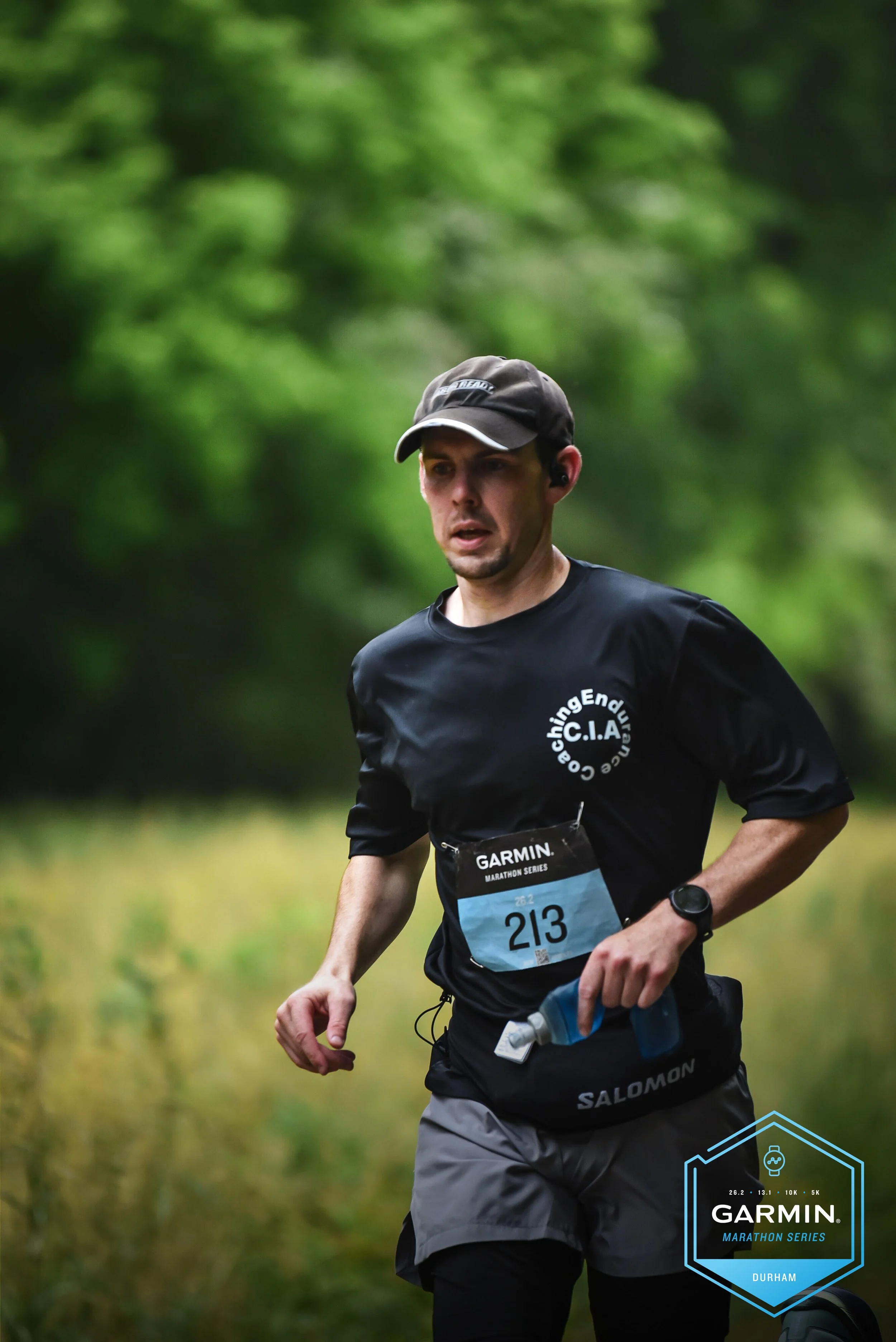
Running the Garmin Durham Marathon
After looking for a local marathon in April/May, the only two options were the New River Marathon and the Garmin Marathon Series Durham (their first year doing a marathon in Durham). The New River Marathon is where I ran my first marathon back in 2024, so I thought it would be cool to run it again to see how much I had improved since then. However, with a 7-month-old baby and my wife running the half marathon, we opted to go with the closer of the two and signed up for the Garmin Marathon. It’s advertised as having around 1,000 feet of elevation gain, so I knew it was going to be tough to break 2:50:00 on the course and being in May the weather had the potential to be hot & humid.
Fast forward to race day. It was actually great running weather. It was a little breezy and chilly early that morning when we arrived at the race. The forecast was calling for some light rain, but it didn’t seem like it was going to amount to much, so we were excited for the cool mid-50-degree temperatures. Perfect for running!
The race started at 7:00 a.m., and off we went. This was my first time using Garmin PacePro, and I had set it for easier pacing on the hills with a negative split on the back half of the race. I knew I have a tendency to go out too fast and push too hard on the hills, which could lead to burnout later in the race.
This race was no different. I ran the first two miles in 6:02 and 6:03. To run a sub-2:50:00 marathon, you need to average around 6:28–6:29 per mile, so I had already shaved almost a minute off my goal pace in the first two miles. I wasn’t exactly sure what pace I was running because the screens weren’t what I was used to on my watch, since it was my first time using the PacePro plan. It took me a bit to find the screen on my Garmin that showed both my current split and my planned pace for each section, since I had set the plan based on elevation rather than per-mile pacing.
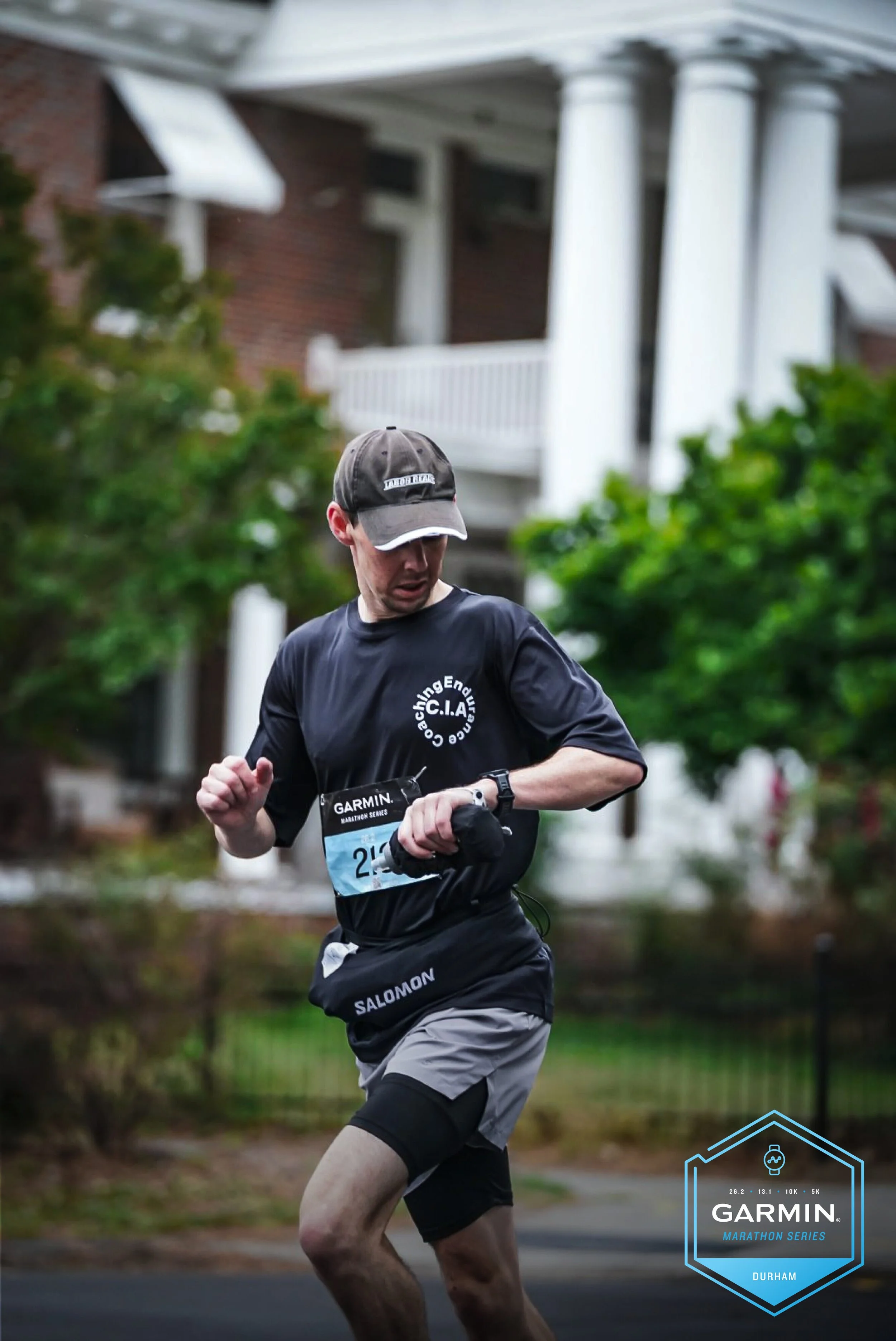
Checking my pace during the Garmin Durham Marathon
Even though I started out fast, I still felt good and settled in nicely. The first 7 miles or so ran through downtown Durham and several neighborhoods doing a sort of a circle back toward downtown. This section is also mostly shared with the HM and 10K runners, so there were other runners around me for most of this section. At mile 8, you get to run inside the Durham Bulls Athletic Park around the baseball field, which was pretty cool. At this point, I was feeling good and had run faster than all of my planned paces. Once we came out of the Bulls stadium, we headed down University Drive toward Martin Luther King Jr. Parkway and eventually onto the Third Fork Creek Trail for a few miles.
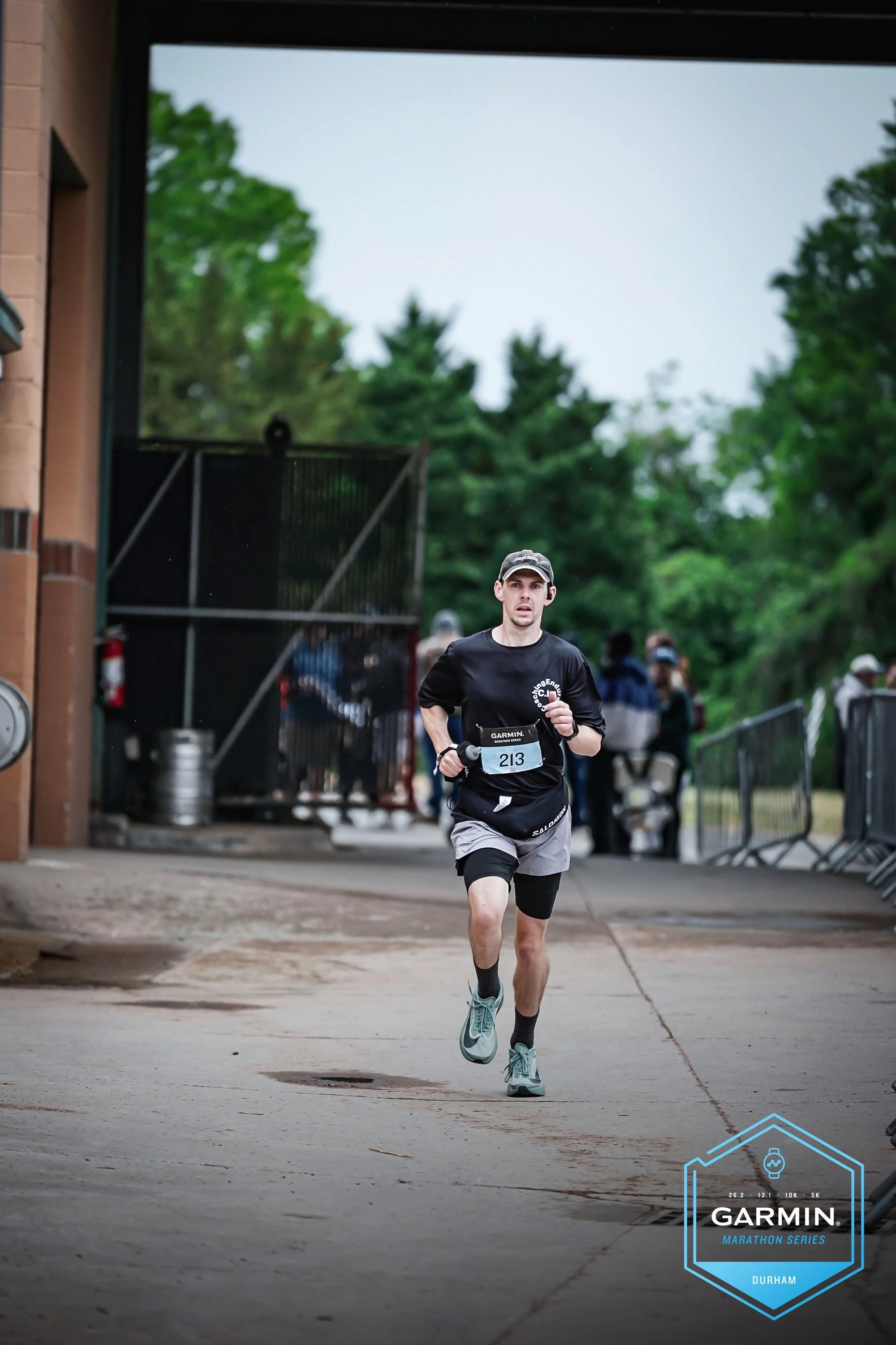
Leaving Durham Bulls Athletic Park - Mile 8.25 of the Garmin Durham Marathon
The section between downtown and the Third Fork Creek Trail had more rolling hills, but the downhills felt more gradual, which made it easier to hold pace for longer stretches. The hills themselves were shorter and punchier, so while they were tough, they didn’t last very long.
Once you get to the Third Fork Creek Trail, you’re at about mile 12, and it’s mostly flat for the next 4–5 miles. Once you come off the trail, there’s a big hill that was really tough at that point in the race (around mile 17). I really wanted to stop, and my legs hurt going up it, but even though my pace slowed, I managed to hold on and ran the hill only a couple seconds slower than my planned PacePro pace. Once I reached the top, there was a nice downhill that allowed for some recovery after the climb, even while running a little faster than goal marathon pace.
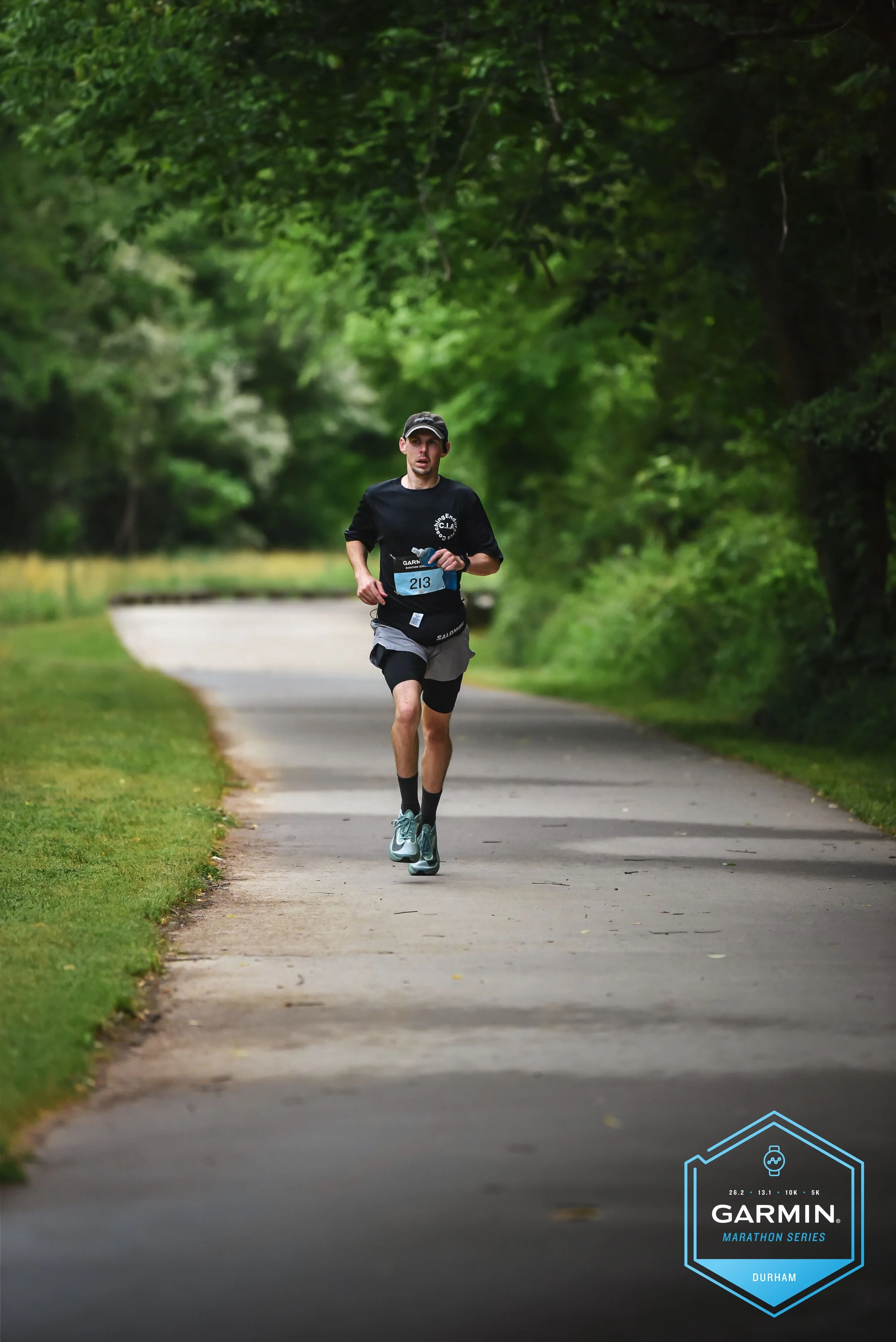
Running on Third Creek Trail during the Garmin Durham Marathon
There are a few rolling hills between miles 17 and 18 until you hit the American Tobacco Trail. This section was mostly flat with a gradual incline to mile 20 and then a nice gradual decline to mile 23. Miles 18–22 always seem to be the hardest part of a marathon. You’ve been running for a long time and still have several miles to go. Your legs hurt and are screaming at you to quit. This marathon was no different.
On the American Tobacco Trail around mile 20, my watch said I was 4:50 ahead of pace, and with just 6 miles to go, I contemplated slowing down because I knew I could still hit my goal of SUB 2:50:00. But doing that would have left me disappointed in my overall effort. I would have reflected on the race afterward and been upset that I didn’t push for a faster time to see what I was capable of.
So, I decided to hang on to my planned pace as long as possible and see what happened. At mile 23.5, you make it back into town and turn left onto Morehead Avenue. From there, there are several rolling hills that were really tough at that point in the race. Again, I wanted to stop and walk the hills, but I told myself to just hang on because we were almost done. Once you get through those hills, there’s a slight downhill for most of the final 0.75 miles.
At the end of Morehead Avenue, you continue straight onto Cranford Road and then turn right onto Academy Road. From there, you’re only 0.3 miles from the finish. Turn right onto Brooks-Pascal Drive and you enter Wallace Wade Stadium, where the finish line is located.
Surprisingly, I was still able to pick up the pace a little and push over the final 0.1 miles to the finish line. To my excitement, the clock read 2:44:?? when I saw it, and I knew I was going to break 2:45:00. My official time was 2:44:53. Honestly, that shocked me. Coming into the race, I didn’t know if I could run sub-2:50:00 on a course this hilly. When I saw the weather was going to be cooler, I got excited because it easily could have been in the 80s with high humidity that time of year, which could have led to a very different result.
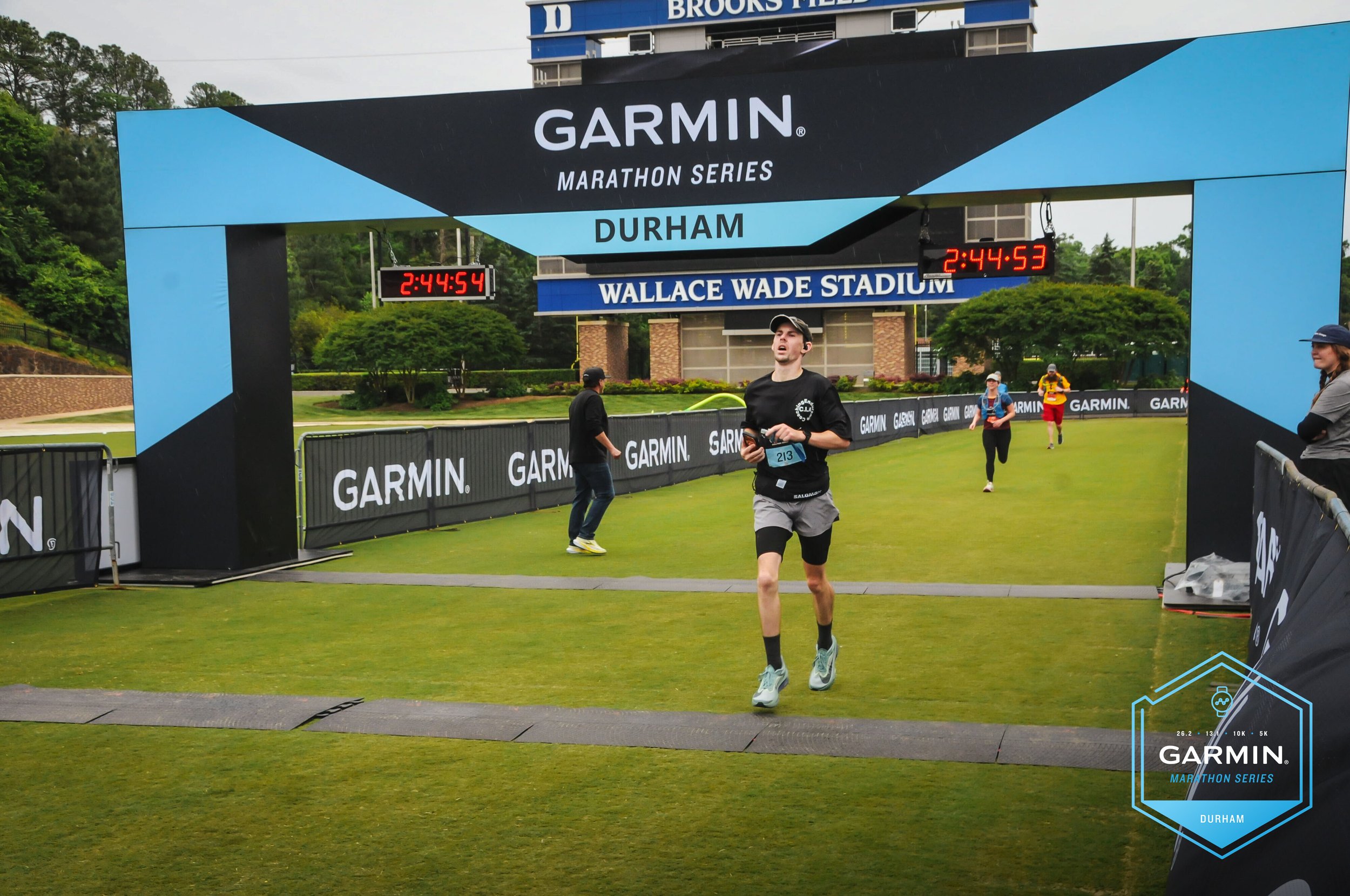
Crossing the finish line in Wallace Wade Stadium at the Garmin Durham Marathon
Overall, it was a great race. Running through downtown Durham was awesome, and people were standing in front of their houses cheering runners on. I think that’s part of why I was able to push so well during those first 8 miles, the energy from spectators and being around other runners helps a lot. Running on the Third Fork Creek Trail and the American Tobacco Trail meant I was mostly running by myself, so those miles were definitely harder mentally because there were far fewer people cheering, and the race energy was mostly gone at that point.
The last few miles were hard because of the hills, but once we got back into town, there were more spectators cheering runners on. The 5K, 10K, and half marathon all shared that section of the course, so there were a lot more runners around me. I was passing a lot of people there, and even though they weren’t running the full marathon, it still gave me energy, especially when people would cheer me on or say things like, “Is that a marathoner? Geeez.”
Finishing on Duke University’s campus inside Wallace Wade Stadium was also really cool, and there was a great atmosphere with spectators in the stands cheering runners on. Overall, it was a great event, and I would definitely run it again!
