
GRINDSTONE 100 MILER RACE RECAP
This was the hardest thing I have ever done. Period!!
During the race, I was constantly thinking about how insane ultra athletes are, especially those at the tip of the spear in the sport. To be able to run and move efficiently in the mountains for hours is an impressively difficult thing to do. The mountains will chew you up and spit you out if you’re not prepared, and even if you are prepared, the mountains will throw something at you to test you mentally and physically.
If you’re looking to test yourself, to see what you’re capable of, to find your limit, run a 100-mile mountain ultra.
I found out my limit (at least on that particular day) was 72 miles. I was mentally capable, my training proved to be effective and was not a limiting factor, and my nutrition went as well as I could hope. My limit was my body.
LET’S START AT THE BEGINNING
This whole training cycle and race just seemed to have a rain cloud over it. After setting my PR in the marathon this spring, I was ready to transition that fitness to running in the mountains. Going from mostly running roads to trails.
I don’t know if I tried to transition too quickly, but if you’ve been following along, you know I developed an injury in my right foot a couple of weeks into starting the training block for Grindstone. And just a couple weeks prior on my first long run on trails I tripped and split between my fingers and had to get stitches.
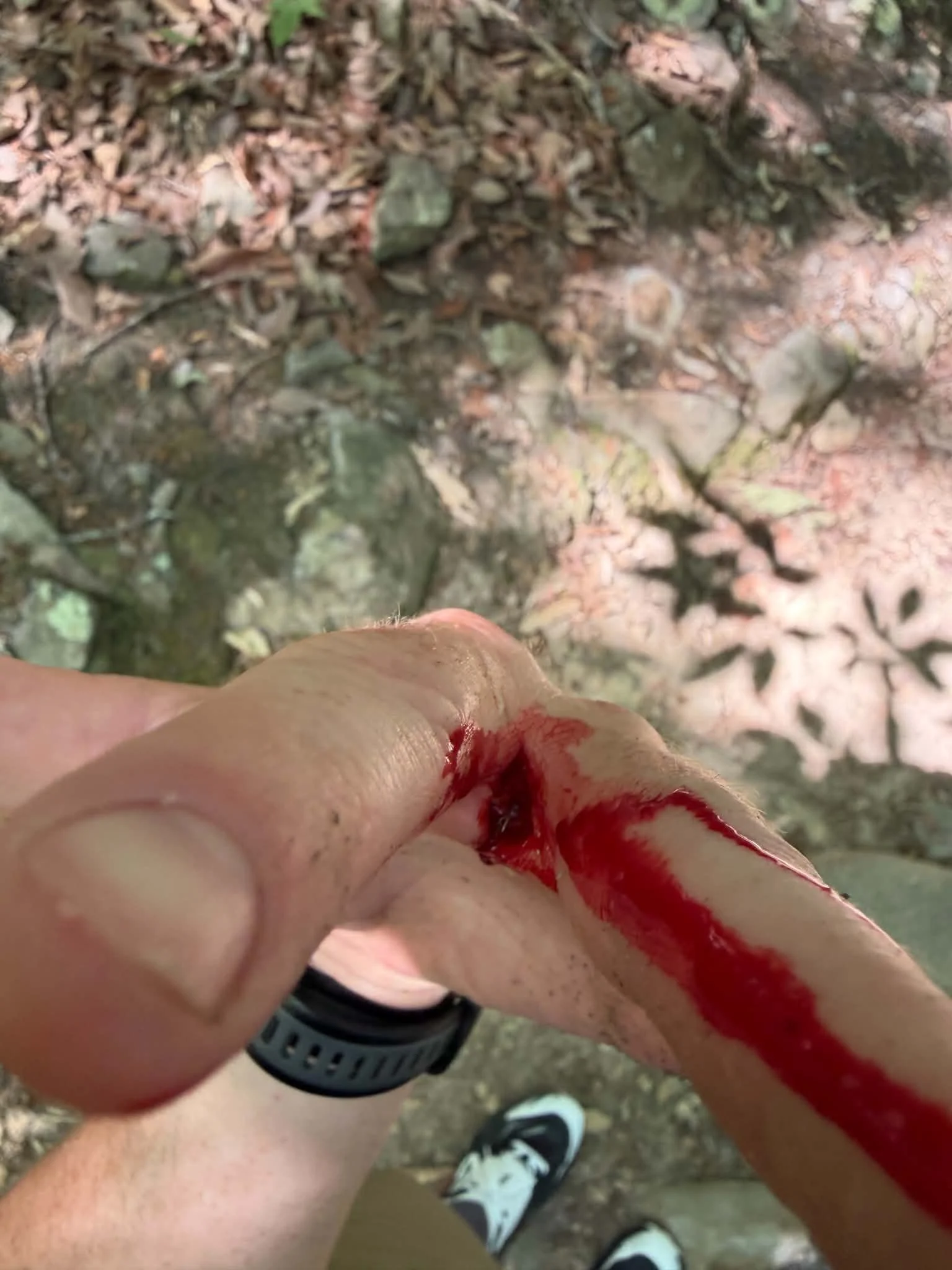
Taken right after falling and cutting my hand
It was two weeks after that when I suffered the foot injury in my right foot. That injury kept me to very little running for 8 weeks and limited what I was able to build up to for peak weekly mileage which ended up being just over 60 miles. I biked a lot, but biking doesn’t strengthen joints and tendons like running does. It doesn’t prepare your body for the amount of impact and force your body is going to have to experience running 100 miles.
I believe this may have contributed to my downfall.
Not only did my injury limit my training, but it also forced me to withdraw from two races this summer (the Cherokee 70K and Grandfurther Mountain 25K), both really fun-looking races that I was looking forward to and had to miss. But my A goal was Grindstone 100, and being healthy for the start of that race was my primary goal.
My foot progressed throughout the summer, and I was able to get some quality training in the month of August. I felt good about my fitness going into the taper.
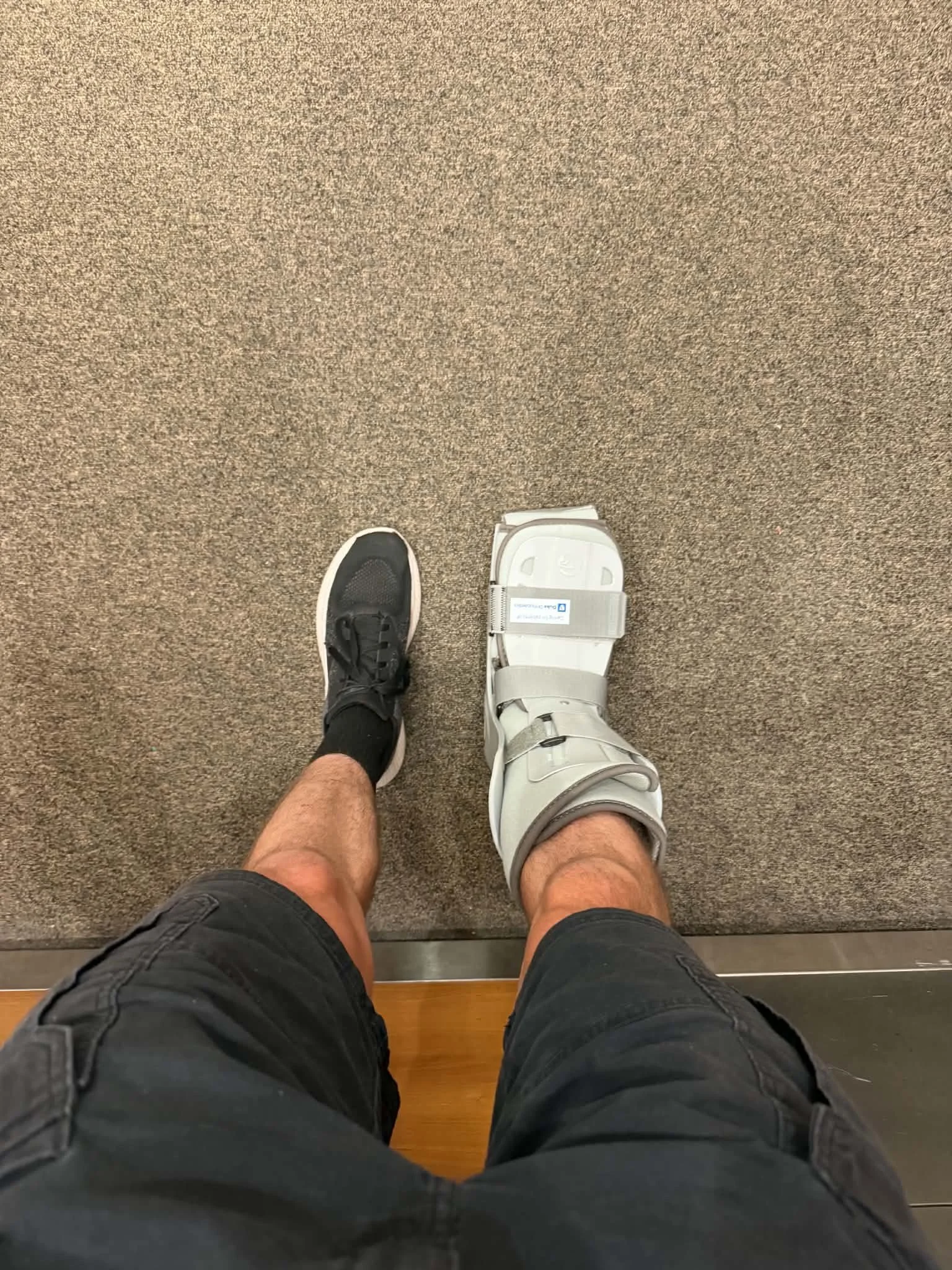
Leaving the clinic after they recommended wearing a boot.
I knew SUB-20 hours was going to be really hard, but I felt it was possible if I executed properly. After doing several long runs in August I felt the fitness was the goal was still possible.
RACE DAY
Fast-forward to the day before the race, and our rental cars check-engine light come on. We didn’t have cell service where we were staying, so I would have to drive about 15 minutes to get service and call the rental company. After calling three different branches, I was able to confirm a replacement vehicle for the following day (the day of the race).
Not ideal to be dealing with all of this the day of the race. I was frustrated at first, but I had to remind myself that I can only control what I can control, and this situation was outside of my control. I could, however, control how I responded and dealt with the situation. So, I told myself to relax, that a 1.5-hour drive (round trip) was still me relaxing before the race. And that I can have a good attitude, so that’s what I did.
After we picked up the new rental car, I tried to lie down and take a nap. I didn’t nap, but I did lie with my eyes closed for about a half hour. Sleep would’ve been ideal, but the rest was nice. We got to the race around 4:00 p.m. to pick up my bib and hear the race briefing. I then got ready, double-checked my gear, put on lube, and just made sure I had everything I needed.
By this time, it was about 40 minutes to the start. I did a 10–15-minute warm-up just to loosen everything up a little. With about 20 minutes to the start, they asked the “elite” males (basically anyone going for the podium or a fast time) to get into the start corral.
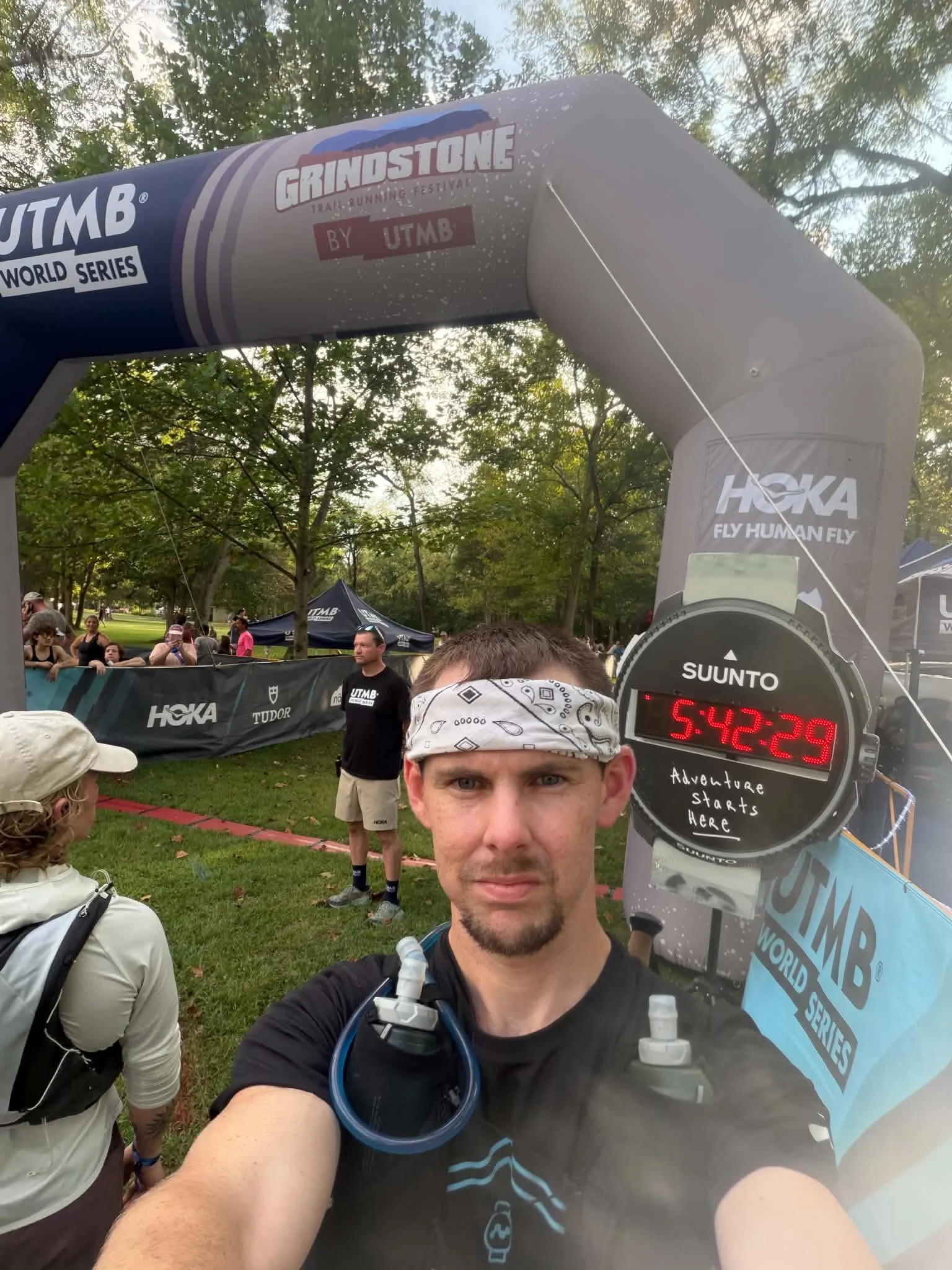
In the start corral
With a few minutes to go, they started to play “Lose Yourself” by Eminem. The atmosphere was electric. Crew, family, spectators were all lined up at the start. Eminem blaring. A shot at making the lottery for UTMB. Twenty or so of us about to compete for that spot.
That energy is something I had never experienced, and in that moment, I knew I wanted to experience it again. To become a sponsored athlete and be able to race big races multiple times a year is a goal I have. I’ve not publicly said that until now. Running these races at a high level takes a ton of work and a lot of money.
One big race is really all we can afford currently. To become able to do this for a living would be awesome. I love the process of training and improving. I love diving into the science and learning how to be the best I can be at this sport.
But I digress. Back to race day. With about 90 seconds until the race start while standing in the corral I realize I forgot to put my headlamp and waistlight on. It was still in the back of my pack. I wanted to beging the race with them on even though it was going to be light for an hour and a half just to save from wasting a few seconds at an aid station doing it. I get them on just in time.
The Eminem song ends, and the count down began.
10…
9…
8…
7…
6…
5…
4…
3…
2…
1…
Goooooooo!
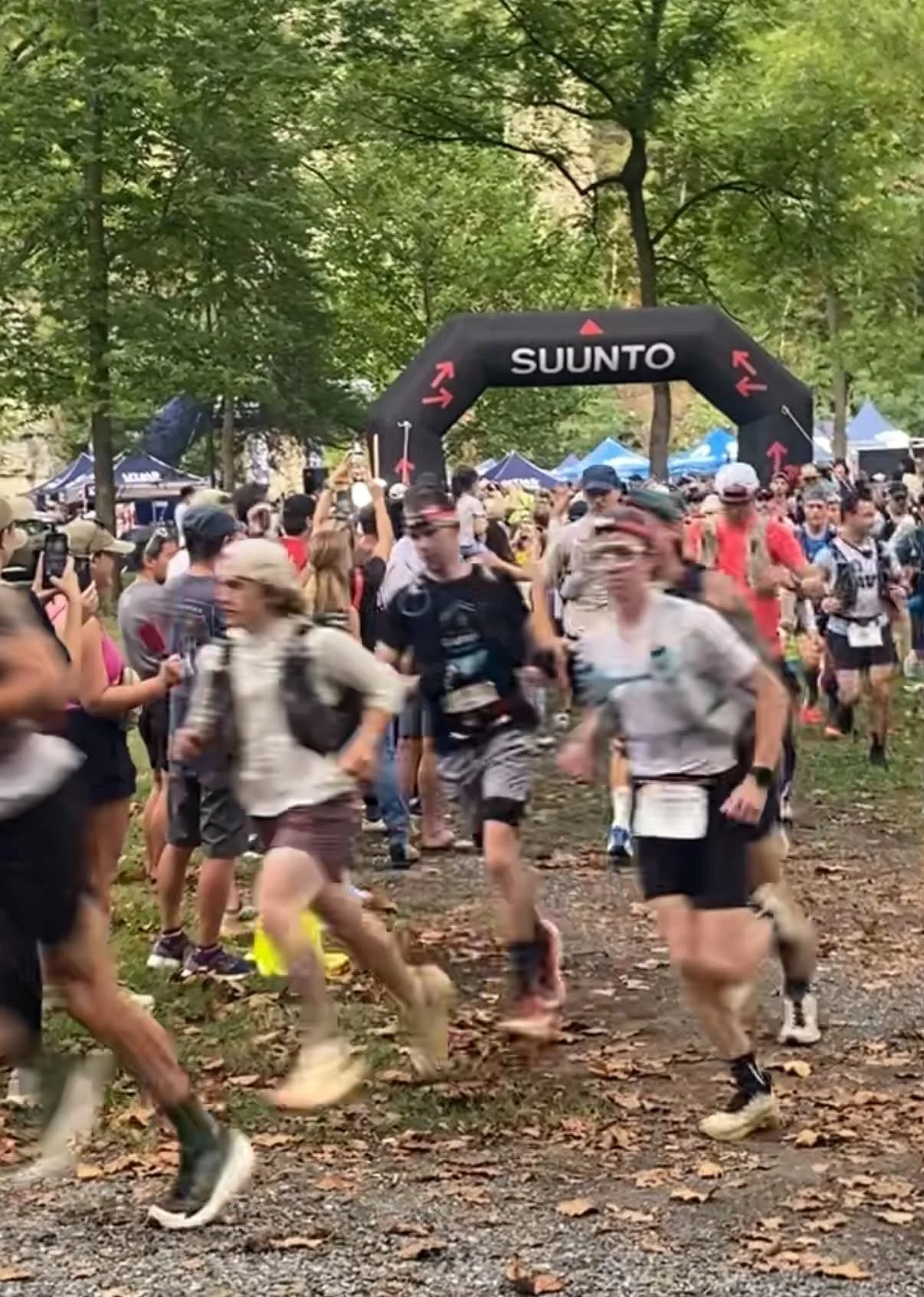
Start of the race
Off we went. I told myself I wasn’t going to go out hot. A half-mile in, I looked at my watch, and we were doing a casual 6:30 average pace! My first mistake of the race.
The group slowed down around a mile in, except for one runner who got a good 2–3-minute lead on everyone.
As we hit the roads, we settled in. Probably five or so of us were all running right together, chasing the leader who was all alone in front of us. I tried to stay right around a 7:20 pace and slowly started to pull away from the chase pack. After a mile or so, I was all alone.
We turned off the road onto a forest service road. Mostly uphill. I pulled my trekking poles off my back and realized my second mistake of the race. The buttons on my trekking poles were stuck with some grit in them. They wouldn’t stay locked in. While running, I was able to get one of them all the way popped out, but the other one was stuck good.
Thankfully, the first aid station was just ahead and was right before we got onto singletrack with a really steep climb. As soon as I got to the aid station (Lick Run, mile 5.7), I asked if anyone had a key or something to try to get the button unstuck. A kind lady volunteer had one, and we fumbled with it but to no avail. A man then tried, and still no luck. He asked one of the other volunteers if they had a screwdriver in their truck. Thankfully, he did and was able to pry the button unstuck.
It seemed like forever, but it only took a few minutes. But those minutes cost me four spots, going from 2nd upon arriving at the aid station to 6th leaving it.
We started the steep climb, and I was at the back of a group of four of us. Once we got to the top, it turned to mostly runnable, flowy terrain. I passed one runner who stopped to relieve himself. Now in 5th.
The four of us all stayed in sight of one another for most of this section and all arrived at Wolf’s Ridge aid station (mile 11.4) within seconds of each other. I left this aid station again in 6th but quickly went ahead of two runners (now in 4th) who had settled into a fast hike as we were starting up the first big climb of the race.
This section goes up Wolf’s Ridge to Reddish Knob. The first few miles are the perfect douche grade. It’s runnable but all uphill. I didn’t want to burn any matches here, so I settled into a very easy jog with some periods of speed hiking. I was moving efficiently and didn’t feel like I was pushing hard, which was my goal for this section.
Again, I was all alone for this section, as I didn’t catch any of the three runners ahead of me and no one caught me. I made it to the Reddish Knob aid station at the top (mile 20.4) and was told 3rd place had just left.
This section is forest road for about 6 miles before hitting singletrack on the Wild Oak Trail for 6 miles of mostly downhill, some steep downhill, with one climb up Grindstone Mountain.
I felt fine for the forest road sections other than beginning to chafe on my legs. I had put two gloves in my pocket that I had put lube on and rolled them up so I could apply it quickly if I had issues. So that’s what I did. I took a minute, put on the glove and applied the lube where I was chafing, and then took off again.
Once I made it to the singletrack, I started to struggle some. My legs felt fine, but my stomach would tighten on the downhill, and I couldn’t run faster than an easy shuffle. It wasn’t cramps, more like I couldn’t catch my breath.
I got passed about halfway down (now in 5th). I was concerned because I was falling behind my goal time for arriving at North River Gap Aid Station, where I would see my crew for the first time. I tried to stay positive but started to question if I was going to be able to finish the race in any kind of respectable time. And began to wonder just how many people were going to pass me if I was moving this slowly on the downhills.
I made it to the aid station and kind of felt like death. My legs didn’t hurt; I just kind of felt tired and burnt out. My wife did great getting everything switched out on my pack and restocked with gels and flasks. I drank some coconut water, ate a granola bar, changed the battery in my headlight, used the Porta-John, and went on my way.
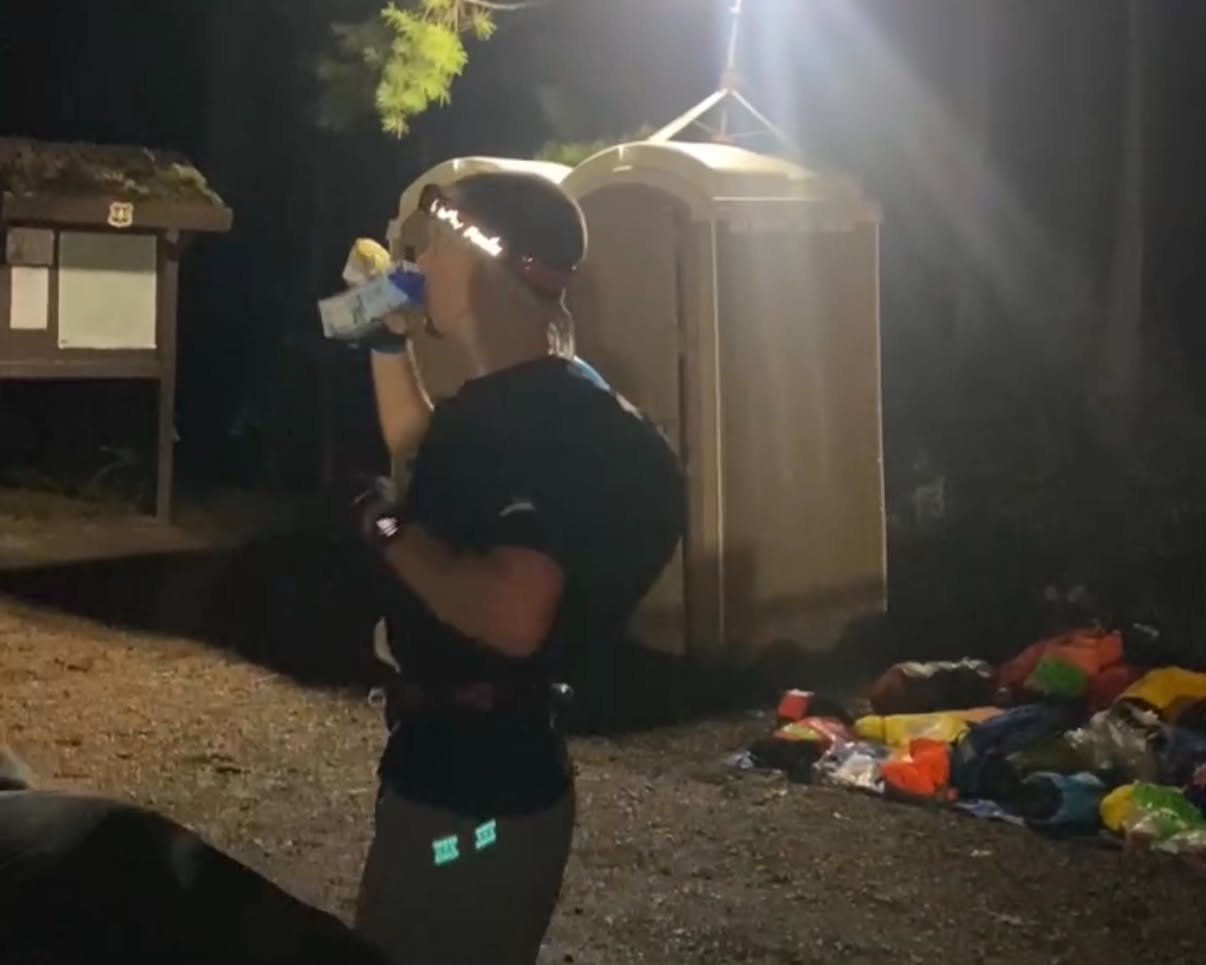
North River Gap Aid Station
I didn’t know it at the time, but two runners were still at the aid station when I arrived, and they were still there when I left. I was now in 3rd and didn’t even know it. Leaving the aid station, I still didn’t feel great. And the first few miles are on singletrack with a bit of climbing. The bottom of my right foot also began to hurt around this time.
I hit a very low point during this section, the lowest of the race. I was telling myself I was done with ultra running. I was thinking there was no way I would make it 100 miles. I honestly wanted to cry at one point. But I was still moving forward.
It turns to forest service road, and it’s more runnable, but I still wasn’t moving great. I caught a glimpse of a light behind me and knew a runner was close. I got to the Lookout Mountain aid station (mile 38.4), and the other runner arrived right behind me. I asked for some Coke and drank about a third of a can. A nice young volunteer refilled my flask with water. I grabbed a slice of watermelon and took off.
My legs suddenly felt better. The pain in my foot didn’t seem as bad. I was regaining life. The forest service road is mostly uphill but also runnable. I started to count my steps. Run 100, walk 100, run 200, walk 100, run 300, walk 100. This helped me work up the hills at a decent pace.
At the top, it turns to singletrack and a slow, steady downhill for 3-ish miles down to the Dowells Draft aid station (mile 45.6), where I got to see my crew. I was able to run the whole downhill even with pain in my right foot, but I was now 45 minutes behind my goal time for arriving at this aid station.
This next section was the hardest of the race, known as the lollipop section, where we would climb up and over Elliott’s Knob, 2,000 feet of gain in 4 miles, followed by a steep, rocky decent with 2,000 feet of loss in 2 miles. It would be 27 miles before I would see my crew again. I had planned on this section taking 5.5 hours, but I knew I wasn’t moving as fast as I had planned. So, I told my crew it would probably be closer to 6 hours and if they wanted to go get sleep this was a good time to do so.
The lead female caught me at Dowells Draft aid station and left before I did. I was now 4th overall, 3rd male, but at the time I still didn’t know I had passed those other two male runners at North River Gap, so I thought I was still in 6th.
The lead woman had about a 50-yard lead on me and slowly started to lose me running through a flatter section. I thought to myself, “I’m never going to catch her. She is killing it,” as I could no longer see her light.
The flat section only lasted a mile or so, and then we began a big 2-mile climb. I chose to just power hike as fast as I could, and slowly I began to catch her. I was moving well going up and caught right up to her. She asked if I wanted to pass, but I told her no. She was also moving really well, and I was still trying to conserve at this point, so I didn’t want to pass her and then feel like I needed to push to lose her.
So I stayed behind her until we got to the top, and then she took off and slowly began to build a small lead, but I stayed within eyesight. At the top, it turned to forest service road that was runnable but did have some really, really steep downhill. We arrived at the Dry Branch Gap aid station (mile 52.6) roughly near the same time.
I needed to refill my flask. I had carried Tailwind with me, so I was putting that in a flask and then filled it with plain water. The other flask I filled with just plain water. While filling my flask, another male runner came in. I jumped in the Porta-John to pee. When I got out of the Porta-John, the lead woman had already left.
I took off after her, still in 4th (still thought I was 6th). The first quarter-mile after leaving was runnable. My foot was hurting, but not enough to make me stop, so I kept a good pace. The trail quickly turned to a steady uphill climb. I went to use my trekking poles, and my right triceps cramped badly. I couldn’t bend my elbow, so my arm was just straight down at my side, and I was dragging my pole.
At this point, my attitude was much better, and I just thought to myself, “Oh well, we will just have to take in some more electrolytes and hope it stops.” It went away after keeping my arm straightened for a bit, and I went to try and use my trekking pole again and immediately it cramped again. This happened a couple of times on this climb and then finally stopped, thankfully!
I again settled into a power hike going up this climb and felt like I was moving well. Near the top, the terrain gets super technical and rocky. It levels out on top, but with the technical terrain, moving was still slow. The parts that were runnable, I was able to move decently, but the pain in my foot was no longer ignorable. I still pushed the best I could but found my running periods were getting shorter due to the pain in my foot.
It was also very foggy on top, and I was only able to use my waist light because the headlamp would bounce off the fog and make it hard to see. This made running in this section a little harder due to how technical it is.
Before I got to the very top, where the trail comes out to a gravel road near the top of Elliott’s Knob, I saw a light. I had again caught up to the female leader. I seemed to be moving better on the uphills, and she was moving better on the flats and downhills.
We got to the top and started back down the steep and rocky descent. It’s roughly a mile or more of super steep downhill and super rocky trail, so moving was slow. The male runner who had caught us at the last aid station caught us again on this descent. We made it to Cold Springs aid station (mile 59.4) all basically together.
We all left at the same time. This section is mostly runnable. Flat gravel for 3 miles and then another two miles of gravel but all uphill. I took a slight lead. Legs felt good, but the foot hurt. After a mile, I had to slow down. The lead female runner caught and passed me. I eventually had to stop. The pain in my right foot was becoming too sharp.
I’d walk a few paces, then get into a shuffle. By this point, I was in the uphill section. The short shuffle uphill seemed to not irritate whatever was wrong with my foot as badly. I was able to tolerate the pain and kept a steady shuffle for a quarter mile or so, then 100 steps walking… back to a shuffle… 100 steps walking. I did this the whole way up and again caught sight of the lead female runner.
We made it back to Dry Branch Gap aid station (mi 64.9). She was just in front of me. Again, my foot was hurting, and I had to use the bathroom, so I took a little more time at the aid station. By the time I left, the lead female runner was long gone, and the male runner who was with us at Cold Springs had passed me (now in 5th). I started back on the stick portion of the lollipop, heading back to Dowells Draft aid station.
I was down to a shuffle on the flats and a slower hike up the hills. I made it to the top and now had a 3-mile steady descent. I went to run, and every step was painful.
I’d step on a rock or root, and a sharp pain would go shooting up the outside of my foot into my ankle. This went on for a couple of miles until I had slowed to a walk… then a limp. I would try to run but couldn’t. The pain was too much. Again, I felt like crying. I think because I knew my day was done.
I still had about 2 miles to go to get to Dowells Draft aid station. It was going to be a long 2 miles. About a mile out, another male runner passed me. I was now in 6th. Finally, I made it. My wife and dad were waiting for me.
As I approached the aid station, I could hear my wife. “C’mon Cam!! You got it! C’mon Cam!” I shook my head. She asked if I needed to sit down, and I said yes. I told her I thought I was done, but I needed to take my shoe off and look first. I was holding on to hope that no visible damage would be there and that I would be able to convince myself that I was just being weak and that I could keep going.
As soon as I took my sock off, I said, “Yep, I’m done.” Swelling and bruising. I hadn’t rolled my ankle or tripped on anything, so it concerned me. It sort of looked like I had sprained it, but I knew I hadn’t.
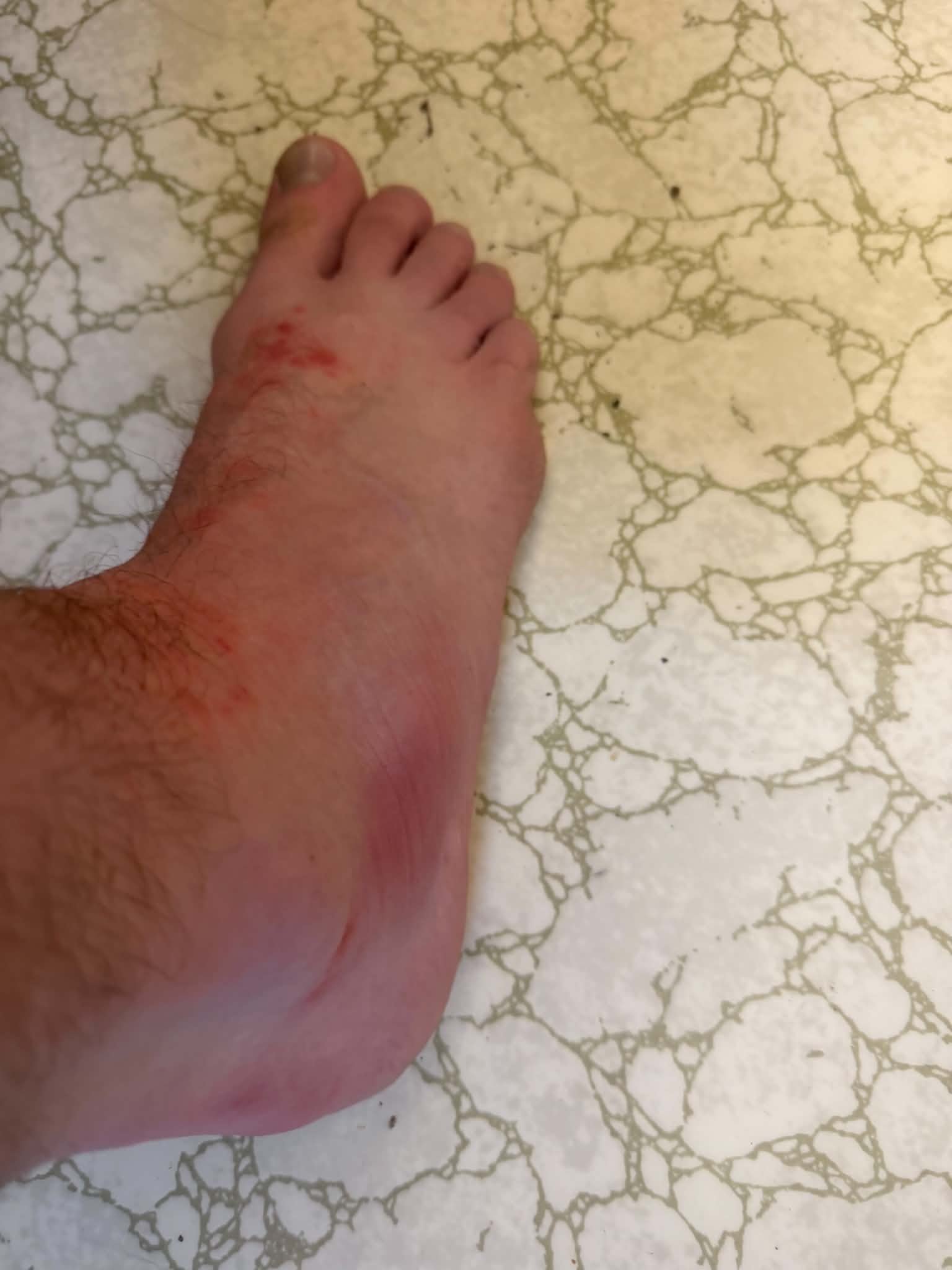
My foot after the race and getting back to the AirBNB
I asked my wife to see if a medic was there, and she went and got them. They were super helpful and were hesitant to tell me to drop out because they understood this was a big race and a lot of training goes into it. They said they could wrap it, and I could try to make it to the next aid station to see if it felt better. I had a brace in my pack, so I put that on to see if it helped, and it hurt worse. It was applying pressure to the bruise with every step. It was now more painful to walk.
I asked them if they would run another 33 miles on it if it were them, and they said no. That was all I needed to hear. I dropped out. It wasn’t worth risking further injury. I already wasn’t sure what I was dealing with or how bad it was, and it wouldn’t have been smart to continue.
I made it 72 miles and ran in the top 5 for basically the whole race, minus a few miles at the beginning and that last mile walking to Dowells Draft. But 6th at mile 72 doesn’t count for anything. A lot can happen in 33 miles. I could’ve blown up or I could’ve caught the leaders. I will never know and dwelling on it won’t change anything.
Could I have continued? Could I have gone 33 miles in 21 hours? Maybe. But for what reason? Pride? That’s all it would have been for at that point. That’s not the reason I want to run 100 miles. My reasons are deeper than that. I’m not trying to be the toughest person or prove that I’m tough. My goal is to be the best I can be, to run 100 miles as fast as I can. That was no longer possible. It seems weird, but the decision wasn’t that hard for me in the moment.
Another factor was my crew. They had already been up most of the night, and I wasn’t going to ask them to wait hours on end for me to get to aid stations and then sit awake through another night with no guarantee of me finishing. They were more than willing to, but I felt that would be extremely selfish. Again, for what reason? Not to help me achieve the goal of being the best I can be, but it would have been to prove I’m tough and to give me pride. It would’ve been selfish to ask them to do that.
I gave it my best effort, and that wasn’t good enough on this day. The reason for dropping was mostly out of my control, and I could accept that. My race as a whole had gone decently well for my first 100-miler.
My nutrition seemed on point. I never tanked and didn’t have any GI issues. My legs still felt decent at mile 72, so I think I would’ve been able to maintain, if not pick up the pace, in the last 50K. They weren’t even sore the next day. I worked through some mental lows. This wasn’t actually the first race where I experienced real mental lows, and admittedly I didn’t handle them perfectly, but I kept moving and came out of them. I learned what it’s going to take to compete and perform at this distance and this type of race.
These are all wins in my book.
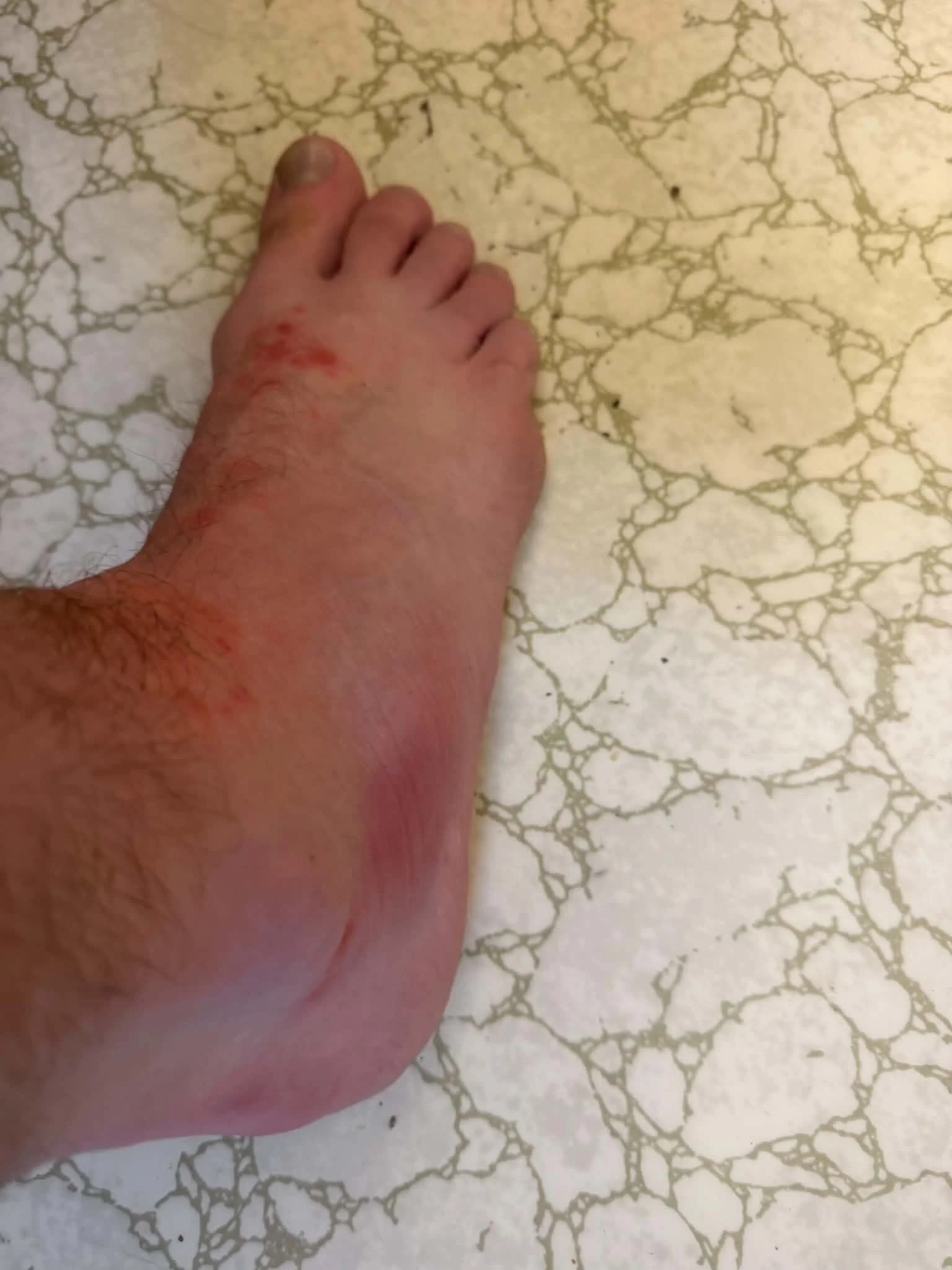
THE DAYS AFTER DNFing
In the days following the race, I’ve had some negative thoughts. I’ve questioned whether or not I should’ve kept going. But all I have to do is look at my foot, currently in a boot, and it’s painful to still put weight on it even 7 days removed. I know I made the right call, as continuing would’ve solely been for my pride and risking further injury.
I’ve also had the thought that it was such a waste of time. All the training, prioritizing the race, spending 7 days in Virginia, the three weekends where I drove 3.5 hours one way to train on course, having my family come up to help. The money spent on all the race nutrition, the race entry, the Airbnb, the rental car. It was all a waste………. if this was the last race I was ever going to run, BUT IT’S NOT!
I learned a lot from the experience. Running 100 miles is super hard, and pacing properly is important. My nutrition plan went well, so confirmation on the work I did, and the gut training is valuable information. I’ll build upon it. My legs were hardly sore after the race. This confirmed the work I did had me fit and prepared, and it also tells me that maybe I was taking it too easy early on and that I could push a little bit harder.
I went through a major mental low around mile 35, but I came out of it and found my legs shortly after. I’ll hold on to this experience, which will help in the next race. And all the training I did is something I’ll build upon. Being good at long-distance running takes years of consistent work. That’s what I plan to do.
I’m currently fired up and ready to take on this distance again. The challenge is amazing, and I’m ready to tackle it again. I’ll take everything I learned and will build upon it to be better prepared for the next one.
The mission continues. Forward Always!
